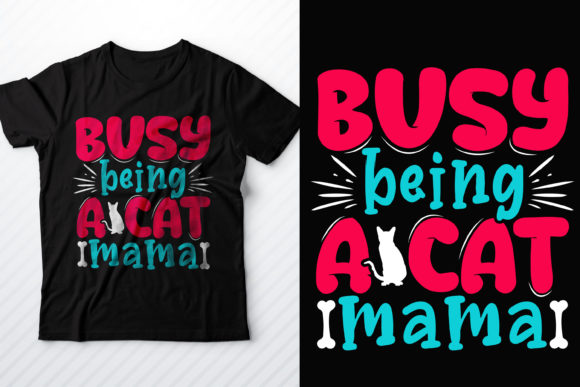
Busy Being a Cat Mama Cat T-shirt Design
As someone who’s stitched hundreds of cat-themed designs—from delicate nursery ones to bold boutique tees—I opened Busy Being a Cat Mama Cat T-shirt Design expecting charm, but what stood out immediately was its quiet confidence. It doesn’t shout “cute”—it leans in with warmth, simplicity, and just enough personality to feel personal without tipping into cliché. The layout balances negative space and visual weight thoughtfully: a centered cat silhouette (slightly stylized, not cartoonish), paired with clean, lowercase lettering that wraps around it like a gentle affirmation. No glitter, no excessive flourishes—just soft curves, consistent line weight, and breathing room. That’s rare in digital graphics aimed at mass appeal.
What This Design Actually Wants to Be Stitched On
Last week, I used Busy Being a Cat Mama Cat T-shirt Design to embroider a lightweight organic cotton tote for a local pet rescue’s volunteer appreciation day. Not as a test—but as the real thing. And it worked beautifully. The design scaled cleanly from 4” to 5.5” without losing legibility, and the open letterforms held up even on slightly nubby fabric. It’s not built for tiny baby onesies or ultra-dense sweatshirt fleece—not without adjustments—but it shines on medium-weight cotton tees, relaxed-fit linen-blend aprons, and canvas totes meant for everyday carry. I’ve also mocked it up on a cream-colored unisex sweatshirt and a sage green tea towel; both felt cohesive, intentional, and quietly joyful—exactly the vibe cat-loving customers respond to.
Where It Fits—and Where It Needs Careful Handling
This isn’t a one-size-fits-all embroidery file. Its strength lies in clarity and calm, not complexity—so it performs best when treated with intention, not speed. On curved surfaces like caps or baseball hats, the lower portion of the text may need slight repositioning or font simplification to avoid distortion. On stretchy fabrics—think ribbed knits or lightweight jersey—use a light cutaway stabilizer and consider reducing stitch density slightly in the fill areas to prevent puckering. Dark fabrics? Test thread contrast first: a warm charcoal gray or deep terracotta works better than stark black for the cat outline, letting the phrase “busy being a cat mama” stay legible without glare.
Small hoop sizes (under 4”) require caution. The current layout assumes at least 4.5” of vertical clearance—the lowercase “a” and “m” in “mama” sit close together, and compressing them too far risks blending. If you’re planning embroidered patches or iron-ons, check how the outer edge aligns with your patch border; the design has no built-in margin, so adding 1/8” bleed is wise. Also note: while the PNG and SVG files are crisp for screen use, the embroidery-ready version (if converted from these) must be digitized with appropriate satin-stitch width and underlay—don’t assume auto-digitizing will honor the subtlety of those curves.
How It Shapes the Finished Product—and Your Customer’s Experience
Embroidery isn’t just about thread—it’s about trust. When someone buys a handmade tote or personalized gift, they’re buying your judgment as much as your stitching. Busy Being a Cat Mama Cat T-shirt Design supports that trust because it feels considered, not generic. It avoids overused tropes (no paw prints, no “meow” puns, no coffee mugs in the frame), which makes it feel more mature and brand-appropriate for small shops, Etsy sellers, and craft fairs where buyers scroll past dozens of similar listings daily. Customers notice when a design breathes—and this one does.
It also elevates perceived value without demanding premium pricing. A simple black-on-cream embroidery reads polished, not DIY. On a linen pillow cover? It whispers “curated,” not “craft store.” On a holiday gift set (tote + tea towel + embroidered bandana), it ties the collection together without needing matching fonts or colors—just shared tone and restraint. That kind of cohesion matters for boutique branding and repeat buyers.
Practical Notes Every Embroiderer Should Run Through
- Test before committing: Stitch a sample on scrap fabric matching your final product’s weight and texture—even if it’s just the cat silhouette alone.
- Check thread color contrast on both light and dark backgrounds using printable mockups. What reads well on screen may vanish on navy twill.
- Review stitch density in the lettering zones—tight fills can stiffen fabric unnecessarily on wearable items like baby onesies or kids’ tees.
- Confirm hoop size compatibility before digitizing or purchasing. If you work primarily with 4x4 hoops, ask the seller whether a scaled-down version exists—or plan minor layout tweaks.
- Inspect fine details at actual stitch size: the curve between “cat” and “mama” should flow, not snag. Zoom in on your embroidery software preview.
- Use proper stabilizer—especially for textured or loosely woven fabrics like canvas or terry cloth. A tear-away won’t cut it here.
- Verify licensing before selling finished items or reselling the digital file. Since this is listed as a Graphics/T-Shirt Designs asset, confirm whether commercial use (e.g., for your Etsy shop or local boutique) is included.
At its core, Busy Being a Cat Mama Cat T-shirt Design succeeds because it understands its audience—not just cat lovers, but the makers who serve them. It’s not flashy, but it’s reliable. Not trendy, but it endures. Whether you’re stitching for a client’s custom order, prepping inventory for a spring craft fair, or building a cohesive line of handmade gifts, this design earns its place in your library—not as filler, but as foundation.