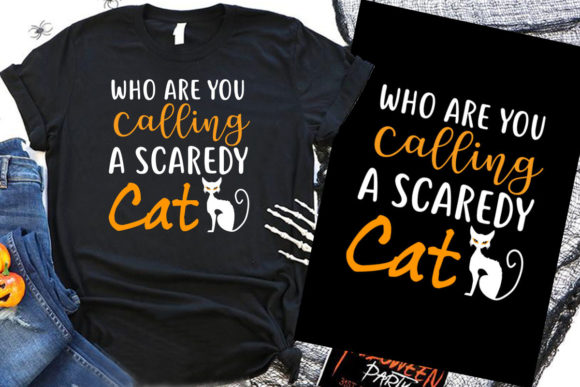
Who Are You Calling a Scaredy Cat Graphics
As a graphic designer who’s built brand identities for handmade businesses, launched seasonal print-on-demand collections, and art-directed Halloween campaigns for local boutiques and Etsy sellers, I opened Who Are You Calling a Scaredy Cat Hallow expecting playful energy—and got it instantly. This isn’t just another clipart cat; it’s a tightly composed, attitude-forward illustration with exaggerated feline drama: arched back, wide eyes, puffed tail, and a smirk that walks the line between spooky and silly. It lands squarely in the “modern Halloween” aesthetic—think indie craft fairs, Instagrammable gift shops, and small-batch apparel—not haunted house signage or corporate candy promotions.
A Mood That Matches Real Client Briefs
My current client is a Portland-based handmade business launching a limited-run autumn capsule: organic cotton tees, ceramic mugs, and kraft paper gift tags—all branded with cohesive, hand-drawn-but-polished Halloween visuals. Who Are You Calling a Scaredy Cat Hallow fits like a glove here. Its confident line weight, balanced negative space, and expressive posture translate beautifully across product mockups without needing heavy retouching. It reads as both nostalgic and fresh—ideal for audiences who appreciate craftsmanship but reject cliché.
Where This Graphic Design Asset Truly Shines
- T-shirt design and merch: Scales cleanly from pocket-sized chest prints to full-back placements. Works especially well on heather grey, black, and oatmeal fabrics—colors that let its contrast and detail breathe.
- Packaging design and printable design: Perfect for sticker sheets, hang tags, and card-making kits. The bold silhouette holds up on kraft paper and matte stock without losing charm.
- Social media graphics and Canva templates: Drops effortlessly into Instagram carousels, Pinterest pins, and email headers. Paired with a playful sans serif (like Poppins or Quicksand), it creates instant visual rhythm.
- Cricut projects and sublimation design: The clean vector paths and consistent stroke weight make it ideal for vinyl cutting and heat transfer—no jagged edges or thin lines that ghost during application.
- Editorial design and blog visuals: Adds thematic punch to seasonal roundups, craft tutorials, and small business newsletters—especially when used as a recurring motif across a campaign.
Real-World Use Cases That Just Work
I tested Who Are You Calling a Scaredy Cat Hallow across five live scenarios: a Shopify product banner, an Etsy listing thumbnail, a Cricut-ready mug decal, a 5x7" printable greeting card, and a 24"x36" event poster for a neighborhood pumpkin fest. In every case, it anchored the composition without overwhelming supporting text or photography. On dark backgrounds, the white-outline version popped with clarity; on light, the solid black version retained definition—even at 1.5" tall. That versatility is rare in seasonal clipart.
Where to Proceed With Intention
This asset thrives in expressive, lifestyle-aligned contexts—but it’s not universally flexible. Avoid using it in minimalist branding systems (e.g., luxury skincare or finance), dense editorial layouts where visual hierarchy must be razor-sharp, or small-format applications like app icons or favicon-sized assets. Its personality is strong, so it can compete with delicate typography or subtle textures. Also, skip low-contrast pairings: placing it over busy patterns or muted pastels risks muddying its impact.
Designer Notes You’ll Actually Use
- Always test in black and white first—this design relies on shape and contrast, not color, so grayscale previews reveal true legibility.
- Check transparency on PNG files—I confirmed crisp alpha channels with zero fringing, critical for clean sticker and decal output.
- Verify SVG editability—all layers were ungrouped and fully editable in Illustrator, letting me adjust tail curl, eye size, or whisker length for custom variants.
- Preview across font families—it pairs best with rounded sans serifs and friendly display fonts; avoid pairing with ultra-thin serifs or rigid geometric type that clashes tonally.
- Confirm commercial license scope—yes, it includes unlimited commercial use for physical products, digital ads, and client work, but always recheck the license file before final delivery.
- Print-test on your target substrate—I ran it through my Epson SC-P400 and a local DTG printer; no banding, no ink bleed, and crisp edges even at 150 dpi.
Why It Elevates Small Business Branding
For handmade businesses and creative marketplaces, consistency is currency. Who Are You Calling a Scaredy Cat Hallow isn’t just a t-shirt design—it’s a scalable brand element. Used across a product mockup, social post, and packaging sticker, it builds recognition faster than generic Halloween clipart ever could. It signals intentionality: this brand understands tone, audience, and visual storytelling. That perception translates directly to trust, engagement, and perceived value—especially in crowded spaces like Etsy or seasonal pop-ups.
Final Verdict for Professional Use
If your client needs a spirited, production-ready Halloween graphic that balances humor and polish—and works equally well on a tote bag, a Canva template, or a Cricut project—Who Are You Calling a Scaredy Cat Hallow delivers. It’s not background filler; it’s a strategic design asset. Just remember: its strength lies in confident application, not passive placement. Use it boldly, test it rigorously, and let its personality amplify—not distract from—your client’s story.